
Table of Contents
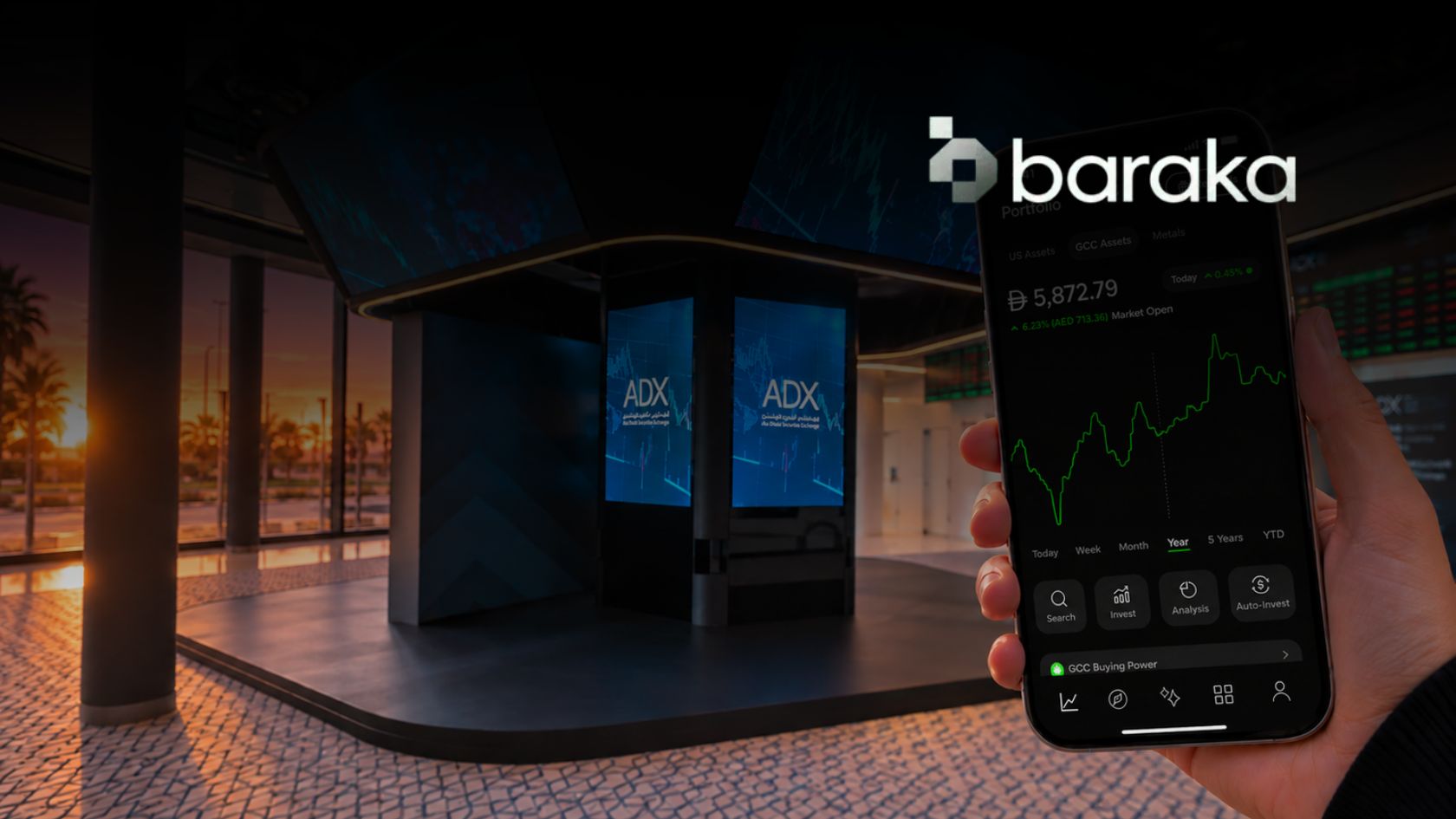
baraka, the DIFC-based investment platform regulated by the Dubai Financial Services Authority, announced on 14 September 2026 that eligible customers can now invest directly in companies listed on Dubai Financial Market (DFM) and Abu Dhabi Securities Exchange (ADX) through its app, funded in AED. The launch extends baraka’s existing UAE and US securities, options trading, Sharia-compliant products and precious metals offering into local UAE equities, taking its total asset coverage to nearly 10,000 across local and global markets through one account.
baraka now lets eligible customers invest directly in Dubai Financial Market (DFM) and Abu Dhabi Securities Exchange (ADX) listed stocks, funded in AED, through the same app used for its existing US and global offering, taking its total asset coverage to nearly 10,000 across local and global markets.
The number of baraka customers investing in UAE stocks has grown more than 25x since an initial pre-launch pilot, and 87% of UAE-stock orders placed since launch have been purchase orders, an early signal of long-term position-building rather than short-term trading.
The launch lands as UAE domestic markets keep expanding: DFM’s market capitalisation reached AED 981.6 billion at the end of H1 2026 with traded value up 40.4% year on year, while ADX’s market capitalisation reached AED 2.8 trillion with more than 30,000 new investors added in the same period, 77% of them foreign.
How the local access works
Local stocks are funded in AED and held in the names of baraka customers, who purchase whole shares rather than fractional units. UAE securities are held under the custodianship of Emirates NBD, and eligible investors can receive dividends paid by UAE-listed companies. Investor Number issuance, normally a separate application step for trading UAE-listed stocks, is now handled through baraka’s own onboarding flow. The DFM and ADX integration itself is facilitated by Arqaam Capital through a Direct Market Access facility.
The stocks that have attracted the most customer interest so far span real estate, energy, banking and infrastructure: Emaar Properties, ADNOC Gas, ADNOC Distribution, Abu Dhabi Islamic Bank and Salik. By August 2026, the number of baraka customers investing in UAE stocks had grown more than 25 times over from an initial pre-launch pilot, and the company says local-market access has consistently been one of its most requested features.
Also, read Tabadul Trading Value Hits $3.68 Billion in H1 2026, Beating All of 2025
Who’s actually using it
More than 70% of baraka’s investors are under 35, and its customer base spans more than 100 nationalities. Among customers who joined in 2026, 42% named long-term investing as their objective, and around two-thirds of funded customers had never invested before joining the platform. Since local investing went live, 87% of UAE-stock orders placed through baraka have been purchase orders rather than sales, an early indicator that customers are building positions rather than trading in and out. baraka says the median annual amount deposited by an active investor has roughly tripled over the past four years.

Feras Jalbout, founder and chief executive of baraka, said:
“The opportunity set in the UAE has expanded dramatically, with the businesses shaping the country’s growth now accessible through its public markets. For Emiratis and residents, this is an opportunity to own a stake in the economy and build their future through equity investments.”
A market that’s been growing underneath the launch
The launch lands as UAE domestic capital markets have been visibly deepening. DFM ended June 2026 with a market capitalisation of AED 981.6 billion, after total traded value rose 40.4% year on year to AED 119.5 billion in the first half, with average daily traded value passing AED 1 billion. DFM added 42,864 new investors in H1, 71.4% of them international. ADX ended the same period with a market capitalisation of AED 2.8 trillion, H1 trading value of AED 171 billion and total trading volume of 50.3 billion shares, adding more than 30,000 new investors, 77% of them foreign.

Khalifa Rabba, chief operating officer of DFM, said:
“Expanding access to DFM-listed securities through regulated digital investment platforms supports our ongoing efforts to broaden market participation and enhance investor accessibility.”
Omar Alserkal, director of product and market development at ADX, said the integration “bolsters our commitment to making Abu Dhabi’s capital market more accessible, connected, and responsive to the evolving needs of investors.”
Why it matters
For retail participation in UAE capital markets
Both exchanges have already been adding tens of thousands of new investors a year through their own channels, the majority of them foreign. A platform like baraka, with a customer base skewing under-35 and drawing from more than 100 nationalities, gives both exchanges a distribution channel into exactly the demographic that policymakers’ broader capital-markets push, including Dubai’s Financial Sector Strategy and Abu Dhabi’s AED 5 billion IPO Fund, is trying to deepen participation among.
For baraka’s own platform strategy
baraka has been expanding outward from a single-market US and ETF investing app since its 2021 DFSA approval, adding options trading, Sharia-compliant products, precious metals and now local UAE equities. Local-market access closes a gap the company itself describes as one of its most requested features, and 87% of post-launch UAE orders being purchases rather than sales suggests it’s landing with customers building positions rather than testing the feature.
What’s next
Whether the 87% buy-order pattern holds up as more customers gain access, rather than reflecting an early, self-selected group of enthusiasts, is the more concrete thing to track.
FAQ
Who can access DFM and ADX stocks through baraka?
Eligible customers, residents and citizens aged 18 and above across the GCC, subject to baraka’s standard eligibility and product availability rules.
How are local stocks held and custodied?
Local stocks are funded in AED, purchased as whole shares, and held under the custodianship of Emirates NBD in the names of baraka customers.
What is baraka?
A DIFC-based investment platform regulated by the Dubai Financial Services Authority, giving customers across the UAE and GCC access to UAE and US securities, options trading, Sharia-compliant investments and precious metals through one account.
Which UAE stocks are customers most interested in?
Emaar Properties, ADNOC Gas, ADNOC Distribution, Abu Dhabi Islamic Bank and Salik are the five names baraka names as attracting the most customer interest so far.

Editor’s Take: The 87% buy-order figure is early and self-selected, the customers moving first into a new feature is a genuinely different signal from a platform simply adding an asset class and hoping for trading volume. Combined with 42% of this year’s new customers naming long-term investing as their explicit goal, and two-thirds of funded customers being first-time investors, the picture baraka is describing is closer to a savings-and-ownership product than a trading app, which matters for how the exchanges themselves should think about this kind of distribution partner.