

Table of Contents
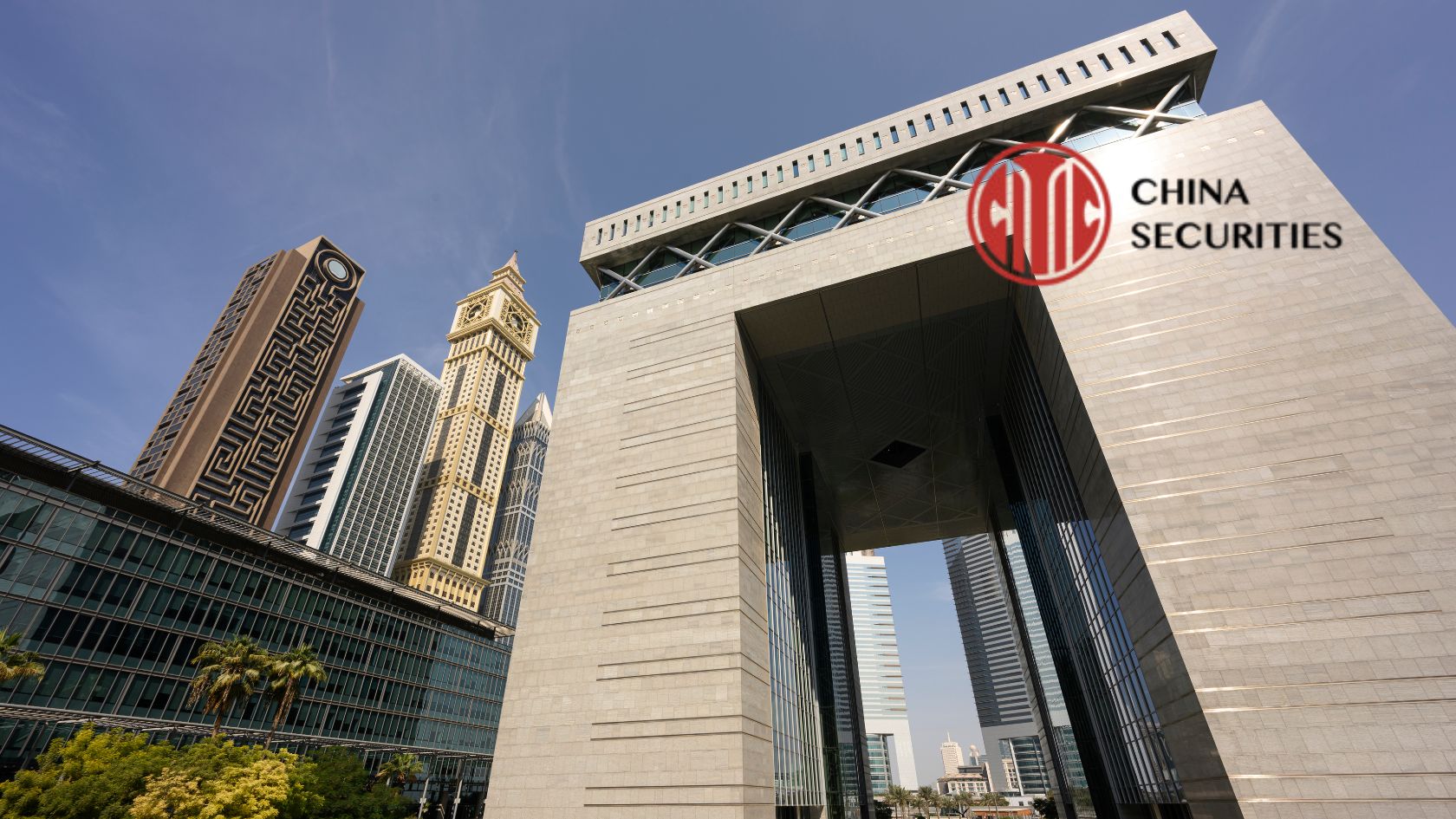
China Securities, a Beijing-based investment bank, has opened a regional office in the Dubai International Financial Centre (DIFC) after being authorised by the Dubai Financial Services Authority (DFSA).
The firm, formally CSC Financial, works in equity and debt capital markets, investment banking, asset management and institutional services. It is listed in Hong Kong and Shanghai, and its largest shareholders are Beijing Financial Holdings Group and Central Huijin Investment, the state investment company. DIFC said the office will serve as a base for the group’s work with clients, investors and financial institutions across the Middle East. Neither DIFC nor the firm has said which activities the DFSA authorisation actually covers, or who will run the office.
China Securities, a Beijing investment bank listed in Shanghai and Hong Kong, has opened a regional office in the Dubai International Financial Centre after authorisation from the Dubai Financial Services Authority.
It joins seven other Chinese institutions already in DIFC; China’s five largest banks hold more than 30% of the assets in the centre’s banking and capital markets sector, according to DIFC’s own figures.
The opening follows a 10 September working group between the DFSA, Nasdaq Dubai, the Hong Kong Monetary Authority and HKEX on market connectivity, whose remit also covers financial innovation.
Also, read DFSA Stablecoin Regulations – What the DIFC Framework Means for Crypto Businesses in 2026
The eighth Chinese institution in DIFC
China Securities joins seven Chinese institutions already established in the centre: Agricultural Bank of China, Bank of China, Bank of Communications, China Construction Bank, China International Capital Corporation (CICC), China Merchants Bank International and Industrial and Commercial Bank of China. Most of that existing presence is commercial banking; China Securities and CICC are the only two securities houses on the list.
China’s five largest banks hold more than 30% of the total assets in DIFC’s banking and capital markets sector, according to the centre’s own figures, a scale of presence that predates this specific opening by some years.
A working group with Hong Kong, not yet specific measures
The opening follows a joint working group announced on 10 September by the DFSA, Nasdaq Dubai, the Hong Kong Monetary Authority (HKMA) and Hong Kong Exchanges and Clearing (HKEX). Its terms cover sustainable finance, Islamic finance, innovation, capital markets development and connectivity between the two markets, though the group hasn’t yet announced any specific measures such as cross-listing arrangements.
Bonnie Y Chan, HKEX’s chief executive, said: “Hong Kong and Dubai have complementary strengths that can help facilitate the two-way flow of capital, ideas and opportunities.” Hamed Ali, Nasdaq Dubai’s chief executive, pointed to the exchange’s “position as a leading international hub for fixed income and Islamic finance listings.” China Securities is the first Chinese securities firm to open in DIFC since the working group’s formation.
Where the fintech angle actually sits
Neither DIFC’s announcement nor China Securities’ own materials mention digital assets, and the firm hasn’t disclosed any virtual-asset licensing for its Hong Kong business, unlike Guotai Junan International, the Hong Kong arm of rival Guotai Haitong, which won SFC approval in 2025 to add virtual-asset trading to its dealing licence. The working group’s remit does include innovation alongside capital markets, though, at a moment when Hong Kong’s regulators have spent 2026 building out tokenised-finance rules: the HKMA granted its first stablecoin issuer licences to HSBC and Anchorpoint Financial in April, and the SFC separately set out a framework for secondary trading of tokenised versions of SFC-authorised products the same month.
The UAE’s own ties to China also run through central bank infrastructure separate from this DIFC opening. The Central Bank of the UAE is a member of mBridge, the multi-central-bank digital currency platform it shares with the People’s Bank of China, the HKMA and the Bank of Thailand, and remains the only Gulf central bank on the platform after Saudi Arabia’s central bank confirmed its own membership ended following the platform’s 2025 proof-of-concept phase.
What’s next
China Securities hasn’t disclosed which specific business activities the DFSA authorisation covers or named who will lead the DIFC office. The working group with Hong Kong also hasn’t announced concrete measures yet, such as cross-listing arrangements between the two exchanges. Whether either develops into something with a direct UAE fintech angle, rather than remaining a capital-markets and banking story, is worth watching rather than assuming.
FAQs
What is DIFC?
The Dubai International Financial Centre, a financial free zone in Dubai with its own courts and regulator, the Dubai Financial Services Authority (DFSA), operating under English common law rather than UAE federal civil law.
Why do Chinese banks open offices in DIFC specifically?
DIFC positions itself as a hub connecting Middle East, African and South Asian markets to global capital, and its common-law framework and DFSA authorisation give foreign financial institutions a regulated base to serve regional clients without separately licensing in every GCC jurisdiction.
Does China Securities’ DIFC office involve digital assets or crypto?
No, based on what’s been disclosed. Neither DIFC’s announcement nor China Securities’ own materials mention digital assets, and the firm hasn’t disclosed a virtual-asset licence for this office, unlike some Hong Kong-based rivals.
What does the DFSA-HKMA-HKEX-Nasdaq Dubai working group actually do?
Announced 10 September 2026, it’s a working group covering sustainable finance, Islamic finance, financial innovation, capital markets development and market connectivity between Dubai and Hong Kong. As of this piece, it hasn’t announced specific measures like cross-listing arrangements.
Editor’s Take: This is a banking and capital-markets connectivity story between Dubai and China, not a fintech product launch, and the innovation-working-group mention shouldn’t be stretched into more than it currently is. The strongest, most concrete fact is DIFC’s own figure: China’s five largest banks already hold more than 30% of the centre’s banking and capital markets assets, which frames this opening as an incremental addition to an already-large presence, not a new entry into the market. The weakest part is the digital-assets connection: it exists only because the Dubai-Hong Kong working group’s remit happens to include innovation, while Hong Kong separately builds out stablecoin rules, two facts sitting next to each other rather than a demonstrated link.