
Table of Contents
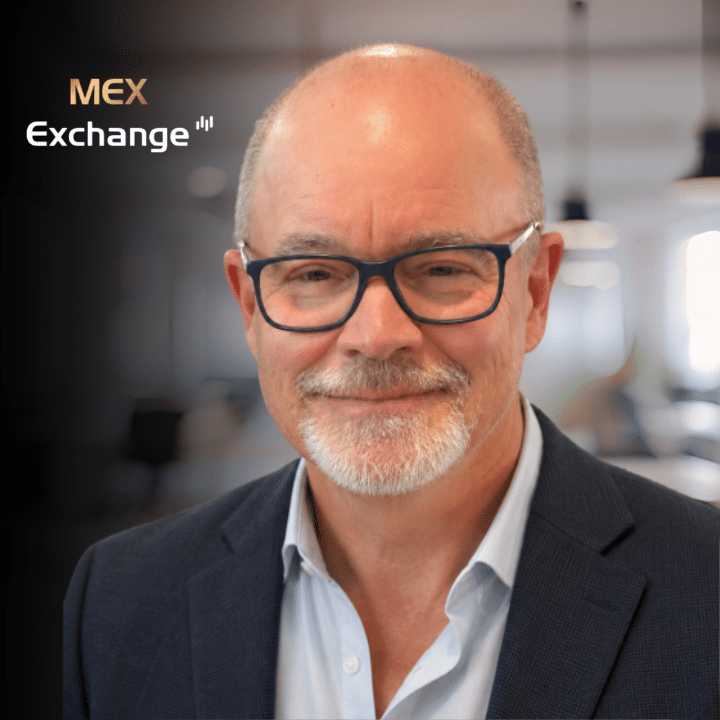
David Ogg co-founded HotspotFX in 1999. It went live in 2000 as the first institutional ECN in the FX market, and it is now part of Cboe FX after Knight Capital bought it in 2007. He went on to build LavaFX, then joined MultiBank Group to launch MEX Exchange, the institutional ECN it opened in Dubai in May 2024. At the end of August he moved from CEO to Vice Chairman, handing day-to-day running of the business to Brian Andreyko.
An ECN is a different layer of the market from the trading apps most readers know. It is the venue where banks and large institutions trade currencies with each other. We asked Ogg to explain it in plain terms, why he built MEX in Dubai rather than London or New York, and what it actually changes for a bank in the UAE.
Key Takeaways
Ogg says many GCC banks can’t get onto the major global ECNs, so they trade with the small number of banks willing to extend them credit. The result is less liquidity, less price competition and wider spreads.
His answer is MEX Prime, MultiBank’s prime-brokerage arm, which gives institutions access to MEX Exchange and to other major global venues.
He argues the leading ECNs have been concentrated in the US and UK, leaving institutions elsewhere without comparable electronic liquidity, and that Dubai’s position between Asia, Europe, the Americas and Africa makes it the right base to serve them.
The Interview
You built HotspotFX in 1999 and it’s still referenced as the platform that defined what an institutional ECN is. For readers who’ve never worked in institutional trading, what does an ECN actually do that a regular trading platform doesn’t, and why did that gap matter enough for you to spend your career building the infrastructure for it?
David Ogg: Before I founded HotspotFX, electronic communication networks (ECNs) in foreign exchange were largely closed environments available only to banks. An ECN differs from a conventional trading platform by bringing multiple institutional buyers and sellers into a single, neutral marketplace, where orders are matched electronically rather than handled through a dealing desk.
I saw a clear need to extend that access to buy-side institutions. HotspotFX became the first institutional FX ECN to enable true all-to-all trading between banks and buy-side firms. It was also the first ECN to use prime brokerage in a way that allowed buy-side institutions to trade anonymously with one another without requiring direct bilateral credit lines. That combination of open access, anonymity and credit intermediation was a major innovation for the FX market.
You’ve spent forty years in a trading industry historically centered in London, New York and Chicago. What made Dubai the right base to build MEX Exchange from, not just as a matter of MultiBank’s own headquarters, but as a genuine bet on where institutional trading infrastructure is heading next?
David Ogg: The leading ECNs have traditionally been concentrated in the United States and the United Kingdom, leaving many institutions elsewhere without comparable access to electronic liquidity. That creates a significant opportunity for MEX Exchange to serve institutions across the GCC and other underserved markets.
Dubai is an ideal base for that ambition. It is a major international center for finance and commerce, positioned between Asia, Europe, the Americas and Africa, and supported by a growing community of banks, investment firms and trading businesses. Locating the ECN here allows us to serve the region directly while building a genuinely global marketplace for institutions that have historically been underserved by Western platforms.
MEX Exchange is aimed at banks and institutions in markets that established Western ECNs have historically underserved. What does that actually change for a bank here in the UAE or the wider GCC, what could they not get access to before that they can now?
David Ogg: Many banks in the GCC have limited access to the major global ECNs and therefore trade with a relatively small number of banks willing to extend them credit. That can restrict liquidity, reduce price competition and result in wider spreads.
Through MEX Prime, our prime-brokerage arm, institutions can access both MEX Exchange and other major global trading venues. This gives them the opportunity to trade against deeper liquidity and more competitive pricing. MEX Exchange also offers the fastest FX matching engine, with execution measured in nanoseconds, together with the most intuitive, user-friendly institutional front end. As execution speed becomes increasingly important, that combination of access, liquidity and technology can make a meaningful difference.

Editor’s Take: Ogg’s first and third answers describe the same fix, 25 years apart. HotspotFX let buy-side firms trade without bilateral credit lines because a prime broker stood in the middle. MEX Prime applies that to GCC banks, whose problem, in his telling, is that only a handful of counterparties will extend them credit. So the product that matters most for a UAE bank is the prime-brokerage arm, not the nanosecond matching engine. Speed doesn’t help a bank that can’t get credit to trade in the first place. A MEX Prime client number, or the first GCC bank willing to be named, would say more than any claim about execution speed.
Read more interviews of the founders and c-suite executives in Fintech on UAE Fintech Vibes.
1 comment
[…] global presence, lead MB.io into new international markets and oversee the expansion of MultiBank Exchange. He will also build partnerships with financial institutions, governments and sovereign wealth […]
Comments are closed.