
Table of Contents
A VARA licence allows a crypto business to offer regulated virtual asset services in or from Dubai. It comes with capital, staffing and compliance duties that shape the whole business plan. The Virtual Assets Regulatory Authority licenses exchanges, brokers, custodians, lenders and other virtual asset service providers, and applicants go through two stages.
This guide explains how to get a VARA licence in Dubai, including the main VARA licence requirements, the application steps, and the fees and capital founders should budget for. We checked the figures against VARA’s published regulations and rulebooks on 1 November 2026. VARA can change them, so confirm them with VARA before you commit funds.
Key takeaways
A firm that carries out virtual asset activity in or from Dubai, outside the DIFC, must be licensed by VARA before it starts. The process has two stages: an Approval to Incorporate, then the full VASP licence.
VARA’s regulatory charges are an application fee of AED 40,000 or AED 100,000 for the first activity and an annual supervision fee of AED 80,000 or AED 200,000 for each activity. Paid-up capital is extra, from AED 100,000 for advisory to AED 1.5 million or more for an exchange.
VARA publishes no timeline. Applicants also need two Responsible Individuals, a private office for every activity except advisory, and net liquid assets of at least 1.2 times monthly operating expenses.
What Is the Virtual Assets Regulatory Authority (VARA)?
VARA is Dubai’s dedicated regulator for virtual assets. It was established under Dubai Law No. 4 of 2022 and is the sole authority regulating virtual assets across Dubai’s free zones and mainland, except the Dubai International Financial Centre (DIFC), which has its own regime. Any firm that wants to carry out virtual asset activities in or from Dubai must be licensed by VARA first, as a Virtual Asset Service Provider (VASP).
The VARA regulations are published as a set of rulebooks. Four are compulsory for every licensee: the Company Rulebook, the Compliance and Risk Management Rulebook, the Technology and Information Rulebook and the Market Conduct Rulebook. Each licensed activity then adds its own rulebook. Reading them early is the most practical preparation an applicant can do.
To see how the regime works in practice, read our coverage of Bybit’s full VARA exchange licence for Dubai and VARA’s proof-of-reserve audit scope.
Who Needs a VARA Crypto Licence in Dubai?
Any firm offering regulated virtual asset services in or from Dubai needs a licence before it starts. That includes companies already incorporated in Dubai and overseas groups that plan to serve Dubai customers through a local entity. A VARA crypto licence in Dubai covers one or more defined activities, and VARA can decline to issue a licence if an activity falls outside its perimeter or the firm doesn’t meet appropriate standards to be regulated.
The licence also shapes who you can serve. According to VARA’s FAQ, licensed firms may serve retail customers once the licence is approved, although VARA can limit certain firms to qualified investors and institutional clients.
Why Crypto Firms Seek a VARA Licence
A licence places the firm under defined rules on custody, market conduct, technology and disclosures, and VARA’s public register lets anyone check a licensee’s activities and licence date. The cost is capital and workload, so founders should compare the Dubai crypto licence route with their commercial plans before filing.
Regulated Activities Under a Dubai Crypto Licence
The licence is activity-based. Choose exactly the activities you will run, because capital, fees and compliance duties apply to each one. VARA regulates eight activities:
- Advisory Services: advising clients on virtual assets.
- Broker-Dealer Services: buying and selling virtual assets for or with clients.
- Custody Services: safekeeping virtual assets or the means of access to them.
- Exchange Services: operating a trading platform for virtual assets.
- Lending and Borrowing Services: virtual asset lending and borrowing.
- Management and Investment Services: managing portfolios or funds of virtual assets.
- Transfer and Settlement Services: moving and settling virtual assets.
- VA Issuance, Category 1: issuing virtual assets under VARA’s issuance rules.
Two structural rules apply. A custodian must be set up as a distinct legal entity with a standalone licence, according to VARA’s licensed activities page. And licensed firms can’t trade their own book or their group’s assets under an activity licence: proprietary trading needs a separate company and a VARA No Objection Certificate.
VARA’s public register also lists exchange services ‘including exchange traded derivative services’ as a separate category. Bybit’s recent licence covers spot trading only, as we reported.
VARA Licence Requirements: What Applicants Must Have in Place
The published VARA licence requirements combine legal structure, people, premises, capital and documentation. The core items are:
- A suitable legal entity. VARA says an LLC or free zone company is preferable, and sole proprietorships aren’t accepted.
- Two Responsible Individuals. Each must be a full-time employee of the VASP, approved by VARA as a fit and proper person, and a UAE resident or UAE passport holder.
- A physical Dubai presence. VARA requires a private office for every activity except Advisory, and sets no minimum size. Advisory firms still need a physical presence to operate from Dubai.
- Paid-up capital. The amount depends on the activity and on fixed annual overheads (see the table below).
- Net liquid assets of at least 1.2 times monthly operating expenses, held in cash and cash equivalents or in USD or AED-referencing virtual assets that VARA approves.
- Compliance and technology frameworks. These include AML/CFT policies, KYC procedures, governance documents, cybersecurity measures and a regulatory business plan.
- An evidence pack. VARA’s list is non-exhaustive. It starts with the certificate of incorporation and covers beneficial owners, source of funds, insurance, proof of paid-up capital, a succession plan and a wind-down plan.
Clean, complete submissions save time, because VARA can refuse a licence where a firm doesn’t meet its standards.
VARA Licence Application Process: Step by Step
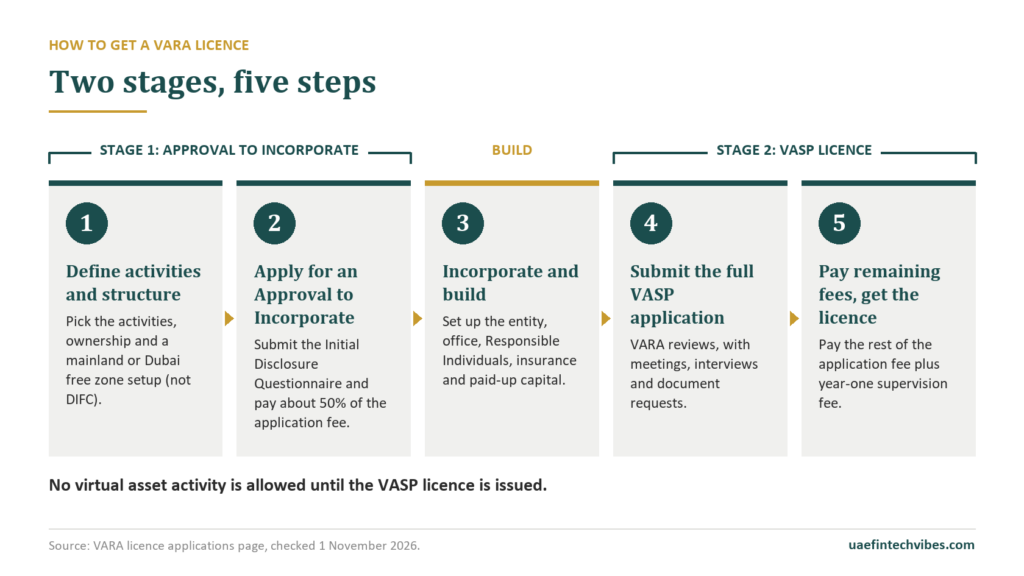
The VARA licence application process runs in two stages, according to VARA. Understanding the sequence helps you avoid paying for office space or hiring before you’re allowed to operate.
Step 1: Define your activities and structure
Anyone asking how to get a VARA licence in Dubai should begin here. Confirm the business model, ownership, group structure and the exact activities you need. Decide whether to incorporate on the mainland or in a Dubai free zone other than the DIFC. Applications go through Dubai Economy and Tourism (DET) for mainland firms, or through a Dubai free zone.
Step 2: Apply for an Approval to Incorporate
You submit an Initial Disclosure Questionnaire with a business plan, beneficial owner details and senior management information, and pay the initial fees, typically 50% of the licence application fee, according to VARA. If VARA is satisfied, it issues an Approval to Incorporate. This lets you finalise the company and complete operational setup, but you can’t carry out any virtual asset activity yet.
Step 3: Incorporate and build the operation
Set up the entity, lease the required office, hire the Responsible Individuals, arrange insurance and fund the paid-up capital. Advisers often describe opening a bank account as the slowest step, so start early.
Step 4: Submit the full VASP licence application
Prepare the documentation according to the guidance VARA gives after the Approval to Incorporate. VARA gives feedback that can include meetings, interviews and requests for more documents.
Step 5: Pay the remaining fees and receive the licence
You pay the remaining licence application fee and the first year’s supervision fee, and receive a VASP licence that may carry operational conditions.
This is the practical answer to how to get a crypto licence in Dubai: first an Approval to Incorporate, then operational readiness, then the VASP licence.
VARA Licence Cost: Fees and Paid-Up Capital
The VARA licence cost has three regulatory parts: an application fee, an extension fee for each additional activity, and an annual supervision fee. Under Schedule 2 of the Virtual Assets and Related Activities Regulations 2023, the application fee for the first activity is AED 40,000 or AED 100,000, depending on the activity. Each additional activity costs 50% of the lower application fee. If an application is denied or withdrawn, no fees are refunded.
| Activity | Application fee | Annual supervision fee | Paid-up capital (higher of a floor or a share of fixed annual overheads) |
|---|---|---|---|
| Advisory Services | AED 40,000 | AED 80,000 | AED 100,000 flat |
| Transfer and Settlement | AED 40,000 | AED 80,000 | AED 500,000 or 25% |
| Broker-Dealer Services | AED 100,000 | AED 200,000 | AED 400,000 or 15% with a VARA-licensed custodian; otherwise AED 600,000 or 25% |
| Custody Services | AED 100,000 | AED 200,000 | AED 600,000 or 25% |
| Exchange Services | AED 100,000 | AED 200,000 | AED 800,000 or 15% with a VARA-licensed custodian; otherwise AED 1,500,000 or 25% |
| Lending and Borrowing | AED 100,000 | AED 200,000 | AED 500,000 or 25% |
| Management and Investment | AED 100,000 | AED 200,000 | AED 280,000 or 15% with a VARA-licensed custodian; otherwise AED 500,000 or 25% |
| Category 1 VA Issuance | AED 100,000 | AED 200,000 | As specified in the VA Issuance Rulebook |
Source: VARA Regulations 2023, Schedule 2, and the Company Rulebook, Part VI.B (version of 19 May 2025), checked 1 November 2026. The custodian discount also applies where the custodian is ‘otherwise approved during the licensing process’. The annual supervision fee is payable in advance for each licensed activity.
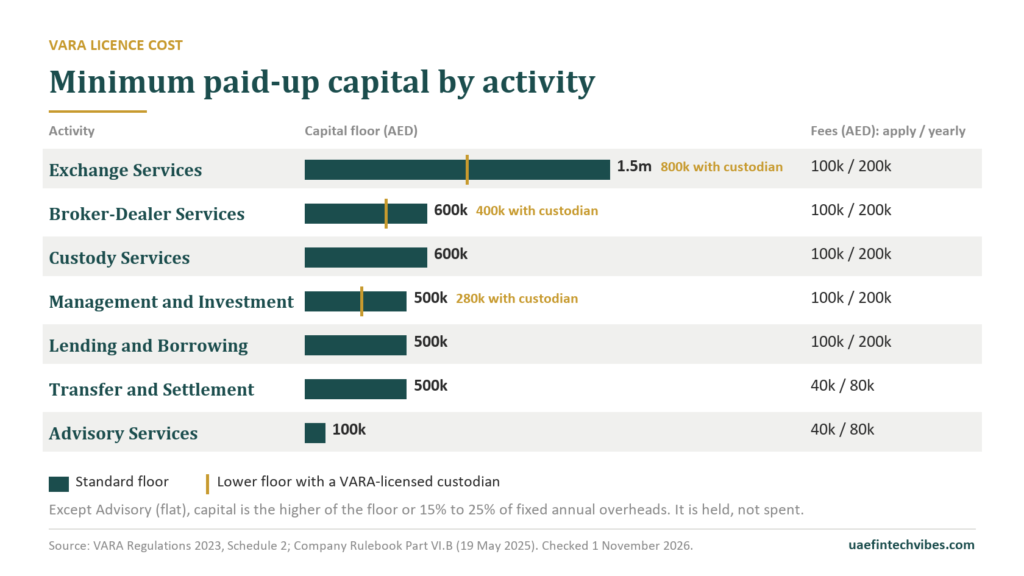
Those are the regulator’s charges only. Capital is held, not spent. The Company Rulebook says it must sit at all times in a trust account with a UAE-licensed bank naming VARA as beneficiary, in a surety bond, or in another manner VARA specifies. A firm licensed for more than one activity must hold the capital for each. You should also budget for the commercial licence, office, salaries, insurance, compliance advisers and legal fees. VARA can modify fees based on a firm’s risk profile and complexity, so treat every figure as a starting point.
As an illustration from the published figures, not a number VARA states: an advisory firm would pay AED 120,000 in VARA fees in year one (AED 40,000 plus AED 80,000) and lock AED 100,000 of capital. An exchange without a licensed custodian would pay AED 300,000 in fees and lock the higher of AED 1.5 million or 25% of fixed annual overheads.
VARA Licence for Crypto Exchange: What Changes
A VARA licence for a crypto exchange sits at the higher end of the fee and capital scale. Exchange Services carries an AED 100,000 application fee and an AED 200,000 annual supervision fee. Paid-up capital is the higher of AED 800,000 or 15% of fixed annual overheads where the exchange uses a VARA-licensed custodian (or one approved during licensing), and the higher of AED 1.5 million or 25% where it doesn’t. An exchange also has to comply with VARA’s Exchange Services Rulebook on top of the four compulsory rulebooks.
Using a licensed custodian lowers the capital floor, which is why the choice of custody arrangement belongs in the business plan.
VARA’s register shows how recent exchange licences have been scoped. Rain MENA FZE holds exchange and broker-dealer services, issued on 5 October, which we covered in Rain MENA FZE receiving a full VARA licence. Bybit Fintech FZE holds exchange services only, issued on 20 October.
How Long Does a VARA Licence Take?
VARA doesn’t publish a fixed timeline for either stage. Third-party advisers estimate roughly four to eight months end to end, and those are their estimates, not VARA’s commitments. How long it takes depends largely on how complete the file is, how quickly the Responsible Individuals are in place, how soon the bank account is open and how well the compliance framework is documented.
VARA’s register also lists firms with in-principle approval, a conditional step that doesn’t permit operating. For two October licences, the gap between the announced in-principle approval and the licence was about five months for Rain (7 May to 5 October) and about four and a half for Kraken’s parent, Payward (21 May to 6 October). Those cover one stage only, so they aren’t an end-to-end timeline.
Plan runway for the full period before any revenue arrives. You may not carry out virtual asset activity until the VASP licence is issued.
Ongoing Obligations After You Are Licensed
The licence isn’t a one-time approval. The rulebook sets continuing duties:
- Supervision fees: the annual fee is payable in advance for each licensed activity.
- Capital: paid-up capital is reconciled monthly. Net liquid assets are reconciled daily and reported to VARA monthly.
- Client reserves: reserve assets must equal 100% of client liabilities, held one-to-one in the same virtual asset, reconciled daily and audited by an independent auditor at least every six months. VARA’s 6 October circular sets minimum checks for those audits, covered in our proof-of-reserve report.
- Insurance: professional indemnity, directors’ and officers’, and commercial crime cover for assets in hot wallets, adjusted to the size of the business.
- Notification: a firm that can’t maintain its capital, net liquid assets, insurance or reserves must notify VARA immediately.
VARA can also impose conditions or require additional capital based on the size and complexity of the business. Budget compliance staff and reporting systems as permanent costs.
Common Mistakes That Delay a Dubai Crypto Licence
- Applying for more activities than the business will run, which raises capital and compliance cost.
- Treating a commercial or free zone licence as if it were the VARA licence.
- Underestimating capital, including the net liquid assets requirement on top of paid-up capital.
- Submitting a thin business plan.
- Leaving banking and Responsible Individual hiring until late.
- Copying policies from another jurisdiction without adapting them to the VARA rulebooks.
VARA vs Other Options for a Crypto Licence in Dubai and the UAE
VARA is the regulator for Dubai’s mainland and free zones outside the DIFC. The DIFC has its own regulator, the DFSA, and firms that prefer Abu Dhabi can look at ADGM and its FSRA, so the right crypto licence in Dubai or the UAE depends on your clients, product and structure. Fiat-referenced payment tokens, including dirham and foreign-currency stablecoins, fall under the Central Bank of the UAE’s Payment Token Services Regulation.
For updates, follow our UAE fintech regulation news.
FAQs
How much does a VARA licence cost in Dubai?
Application fees are AED 40,000 to AED 100,000 for the first activity, and annual supervision fees are AED 80,000 to AED 200,000 per activity. Paid-up capital and operating costs are additional.
Can a foreign company apply for a VARA licence?
VARA welcomes firms from the UAE or overseas, but it needs a legal entity and physical presence in Dubai, so an overseas group normally sets up a local entity first.
Is there a minimum capital requirement?
Yes. Advisory requires a flat AED 100,000. Other activities require the higher of an AED floor or a percentage of fixed annual overheads, for example AED 600,000 or 25% for custody.
Does a free zone licence replace a VARA licence?
No. A free zone or mainland commercial licence lets you incorporate, but regulated virtual asset activity also needs a VARA licence.
Do I need an office in Dubai?
Yes for every activity except Advisory, according to VARA’s FAQ, which sets no minimum size. Advisory firms still need a physical presence in Dubai.
Are application fees refundable?
No. If an application is denied or withdrawn, no fees are refunded.

Editor’s Take: The regulator’s fees are the smaller part of the bill. An advisory firm pays AED 120,000 in the first year, while an exchange without a licensed custodian locks up at least AED 1.5 million in capital before it hires its first Responsible Individual. The register shows how much the scope of the licence matters: the three October licences cover exchange and broker-dealer (Rain), broker-dealer and management and investment (Payward) and spot exchange only (Bybit). Founders should decide the activities, and the custody arrangement, before they pay a fee.
Disclaimer: This article is general information, not legal or financial advice.
Sources: VARA’s licence applications, licensed activities and FAQ pages; Virtual Assets and Related Activities Regulations 2023, Schedule 2; Company Rulebook, Part VI (version of 19 May 2025); VARA’s public register; timeline estimates reported by advisers. VARA may change fees, capital and process at any time.
2 comments
[…] Also, read How to Get a VARA Licence in Dubai – Requirements, Steps and Costs for Crypto Firms […]
[…] Digital’s Dubai arm, ARP Digital FZCO, holds a VARA VASP licence for broker-dealer services, issued on 7 August 2026 and restricted to institutional and qualified investors, according to […]
Comments are closed.