

Table of Contents
AI use among firms regulated by the Dubai Financial Services Authority has more than doubled in two years, according to the DFSA AI Survey 2026, published on 2 November. 71% of respondents reported using at least one form of AI in 2026, compared with 52% in 2025 and 33% in 2024. It is the third edition of the survey.
Key takeaways
71% of surveyed DFSA-authorised firms used at least one form of AI in 2026, against 52% in 2025 and 33% in 2024. Generative AI use rose from 22% to 67% over the same period.
53% of respondents are exploring, testing, piloting or deploying AI agents, but only 14% have reached deployment. Of generative AI users, 91% use it in internal functions and 36% in activities that can affect clients.
75% of generative AI users run third-party applications, and 73% of adopters run 91% to 100% of their AI applications on cloud platforms. The DFSA flags data-security, service-continuity and concentration risks.
What the survey found
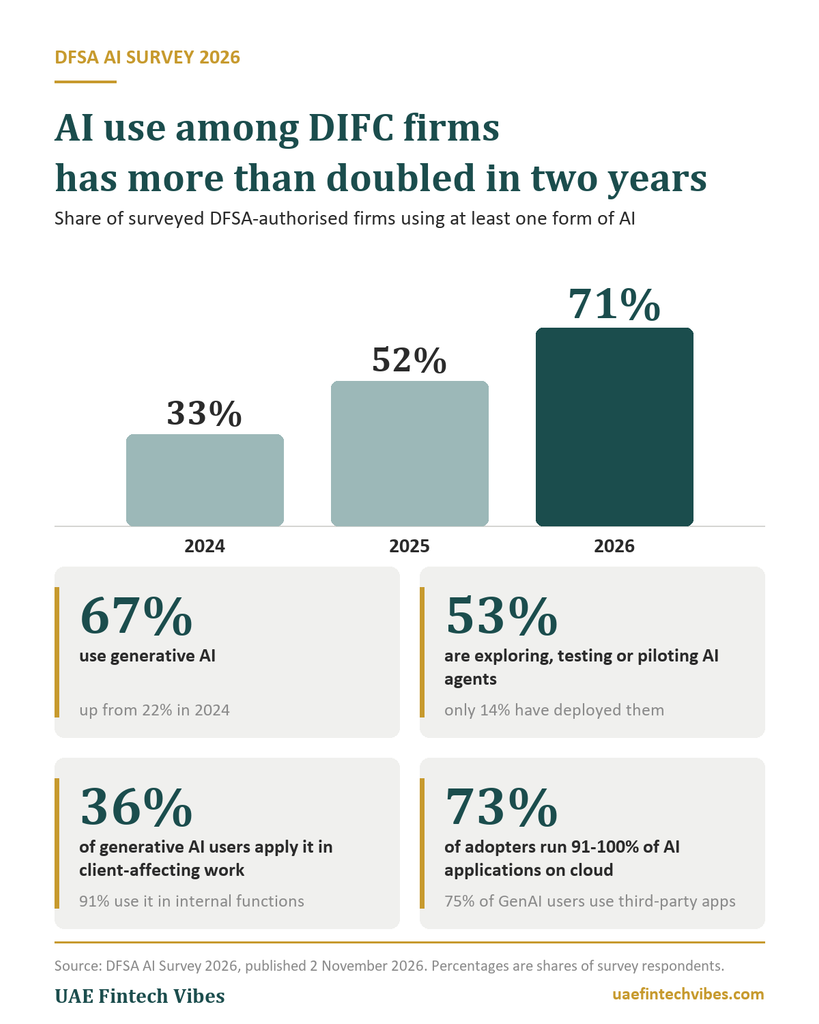
The DFSA’s release reports percentages of respondents. It doesn’t say how many firms answered in 2026 or what share of all authorised firms that represents.
Generative AI drove most of the growth. 67% of respondents used it in 2026, up from 48% in 2025 and 22% in 2024. Among firms that use AI at all, 94% use generative AI. Looking ahead, 84% of respondents expect their AI use to increase over the next three years, compared with 75% a year earlier and 54% in 2024.
Also, read How AI Fraud Detection Actually Works at UAE Banks
Wide adoption, shallow deployment
Adopters are deploying AI more widely inside their businesses. The share reporting deployment across a considerable part of a business area rose from 23% in 2024 to 39% in 2026. Even so, 74% of adopters said at least some of their AI applications were being piloted or used in only a small part of a business area.
Generative AI sits mostly behind the scenes. 91% of its users apply it in internal functions such as HR, legal or finance. Use in internal systems and controls, including audit, compliance and risk management, rose from 39% of generative AI users in 2025 to 52% in 2026. Use in activities that can affect clients or other external parties rose from 33% to 36%.
More third-party AI and more cloud
75% of generative AI users now use applications built by third-party providers, up from 65% in 2025. Firms could select more than one development model, so some also build internally or at group level. 73% of adopters said between 91% and 100% of their AI applications run on cloud platforms, up from 62%.
The DFSA says this increases data-security, service-continuity and concentration risks, and that firms remain responsible for understanding those dependencies and putting governance, security, monitoring and recovery arrangements in place.
Governance is still being built
Among adopters, 61% have an AI governance framework. 53% have organisational policies on AI use and another 28% are developing them. 41% keep an inventory or register of AI use cases and 31% more are building one. Post-deployment monitoring ranges from formal monitoring and reporting to informal or ad hoc arrangements.
AI agents are mostly at the testing stage
53% of respondents reported exploring, testing, piloting or deploying AI agents. Only 14% have reached deployment. The DFSA AI Survey 2026 reads this as significant interest with operational use still early.
The agentic AI paper
On 30 October the DFSA and the Cambridge Digital Innovation and Regulation Initiative (C:>DIR) published a paper on frontier and agentic AI and cyber resilience in the financial sector. It tests resilience on four dimensions: speed, reach, authority and trust. Authority asks whether consequential actions by AI-enabled systems stay within their intended mandates. Reach asks whether institutions understand the shared technology they depend on, including services beyond their direct suppliers.
The paper doesn’t set rules. The DFSA says it is for research and discussion and isn’t legal advice, regulatory guidance, a statement of DFSA policy or an interpretation of the law, and that its illustrative safeguards don’t signal supervisory requirements. DFSA chief executive Mark Steward and C:>DIR’s Bryan Zhang discussed it at the Dubai FinTech Summit on 2 November, the day the survey was published.
What the DFSA will do with the results
The regulator says it will use the findings in risk-based supervision, including its annual technology and cyber-risk self-assessment and its assessment of material AI use, governance and third-party dependencies. It also points to the expectations in its Dear SEO letter on AI risk management and invites early dialogue from firms on higher-impact or emerging use cases.
FAQs
What is the DFSA AI Survey?
An annual survey of DFSA-authorised firms in the Dubai International Financial Centre on how they adopt and use AI, the risks and governance practices that come with it, and how the picture changes over time. The 2026 edition is the third.
How many DIFC firms use AI?
71% of 2026 survey respondents reported using at least one form of AI, up from 52% in 2025 and 33% in 2024.
How many DIFC firms use generative AI?
67% of respondents in 2026, up from 22% in 2024. 94% of AI adopters use generative AI.
Are DIFC firms using AI agents?
53% of respondents are exploring, testing, piloting or deploying AI agents. 14% have reached deployment.
Does the DFSA regulate how firms use AI?
The DFSA sets out supervisory expectations in its Dear SEO letter on AI risk management and uses the survey to inform its supervision of AI use, governance and third-party dependencies. The agentic AI paper is not policy or guidance.
What is C:>DIR?
C:>DIR stands for the Cambridge Digital Innovation and Regulation Initiative. The DFSA’s release describes it as ‘an initiative of Financial Innovation for Impact’. The DFSA wrote the agentic AI paper with it, and its co-creator, Bryan Zhang, joined Mark Steward on stage at the Dubai FinTech Summit on 2 November.

Editor’s Take: Most firms in the survey use AI, but the use is concentrated in internal work, with 91% of generative AI users in HR, legal and finance and 36% in anything that touches clients. Agents are the next step: 53% are exploring them, and the C:>DIR paper’s authority question, whether an agent stays inside its mandate, applies to them first. Cloud dependence points at the paper’s reach dimension too, since 73% of adopters run nearly all AI applications in the cloud. The DFSA will feed the results into its annual technology and cyber-risk self-assessment, so firms should expect questions on AI inventories, which 41% of adopters keep, and on third-party dependencies, which 75% of generative AI users have.
1 comment
[…] Also, read DFSA AI Survey 2026: 71% of Authorised Firms in the DIFC Use AI, Up From 33% in 2024 […]
Comments are closed.