

Table of Contents
The United Arab Emirates has cemented its position as the Middle East’s venture capital powerhouse, with 2025 marking a watershed year for the ecosystem. As we enter 2026, the convergence of sovereign wealth capital, regulatory innovation, and unprecedented AI investment is reshaping not just regional but global venture dynamics. This comprehensive guide examines the data, trends, and strategic shifts defining the UAE’s venture capital landscape.
UAE Venture Capital 2025 Overview
To understand where we are in 2026, we must look back at the pivotal shifts of 2025. The year 2025 was defined by The Great Normalization. The UAE is solidifying its position as the Gulf’s most advanced and globally connected startup hub. Strong deal flow, increasing exits, and deeper international investor participation are reinforcing its pivotal role in regional venture capital.
Record-Breaking Funding Performance

The UAE’s venture capital ecosystem delivered exceptional performance in 2025, defying global headwinds and establishing new benchmarks across multiple metrics. The country raised $541 million across 114 transactions in the first half of 2025, marking an 84% year-on-year increase and the highest deployment since H1 2020. This momentum accelerated through the year, with the UAE attracting $1.2 billion across 59 deals in Q3 2025 alone.
The full-year picture reveals sustained investor confidence. The UAE attracted $2.5 billion in 2025, positioning it as the fourth-largest fintech funding market globally, behind only the United States, the UK, and India. This represents a dramatic evolution from a regional player to a genuinely global venture capital hub.
Deal Dynamics
While total funding reached impressive heights, the composition of deals reveals important market dynamics. Notably, 42% of Series A and B rounds exceeded $20 million in H1 2025, up from just 10% a year earlier, reflecting a growing preference for ventures with proven traction and scalability.
42% of Series A and B rounds exceeded $20 million in H1 2025, up from just 10% a year earlier.
This shift toward quality over quantity signals a maturing ecosystem where investors increasingly back companies with validated business models and clear paths to profitability.
The geographic distribution of investments remained concentrated in Dubai and Abu Dhabi. Dubai hosts 483 venture capital funds while Abu Dhabi hosts 94, making these emirates the undisputed centers of UAE venture activity. However, Abu Dhabi’s ecosystem demonstrated particularly impressive growth trajectories, with strategic government-backed initiatives driving disproportionate momentum.
Sectoral Leadership: Fintech Dominance

Fintech emerged as the uncontested leader of UAE venture capital in 2025. Fintech attracted $516 million in the Middle East in H1 2025, representing 38% of total capital deployed in the region. The sector’s dominance reflects both the UAE’s strategic positioning as a financial services hub and the massive addressable market created by the country’s digitally-savvy population and strategic position between East and West.
UAE fintech startups attracted approximately $265 million in 2024, representing one-third of total startup funding in the country, with the local fintech market expected to grow from $3.16 billion in 2024 to $5.71 billion by 2029. The confluence of regulatory support, digital infrastructure, and consumer adoption created ideal conditions for fintech innovation.
E-commerce ranked second-most funded in the Middle East, with $321 million raised, while enterprise software raised $105 million. The diversification across sectors indicates a maturing investment landscape where capital flows into multiple high-potential verticals rather than concentrating in a single dominant theme.
The Rise of Alternative Financing
One of 2025’s defining characteristics was the emergence of venture debt and alternative financing structures. Of the 180 deals closed in Q3, 134 were early-stage, raising $538.3 million, while later-stage startups drew $981.3 million across 17 deals, with 12 startups raising capital via debt instruments. This trend toward non-dilutive capital reflects founder sophistication and investor willingness to structure creative financing solutions.
The debt market’s growth was particularly pronounced in Saudi Arabia, where mega debt facilities dominated headlines. However, UAE startups increasingly use similar instruments, with the venture debt market expanding due to rising customer preference for alternative financing options and the entry of new venture debt providers.
Sovereign Wealth Catalyzes Growth
- Government-backed investors like Mubadala Ventures are at the center of early-stage capital formation, investing in startups directly or through commitments to private VC managers.
- Mubadala led all sovereign investors globally in 2025, deploying $29.2 billion across 52 deals, spanning Nigerian mobility fintech to Southeast Asian platforms, positioning the UAE as a global capital allocator, not just a regional one.
- MGX, an AI investment vehicle co-announced in March 2024 by Mubadala, G42, and the UAE’s AI & Advanced Technology Council, is targeting $100 billion in assets, marking a structural shift in how the UAE approaches technology investing.
- MGX has since partnered with Microsoft and BlackRock and joined the Stargate Project, signaling ambitions that extend well beyond conventional venture capital.
Venture Capital Outlook: UAE vs. Saudi Arabia
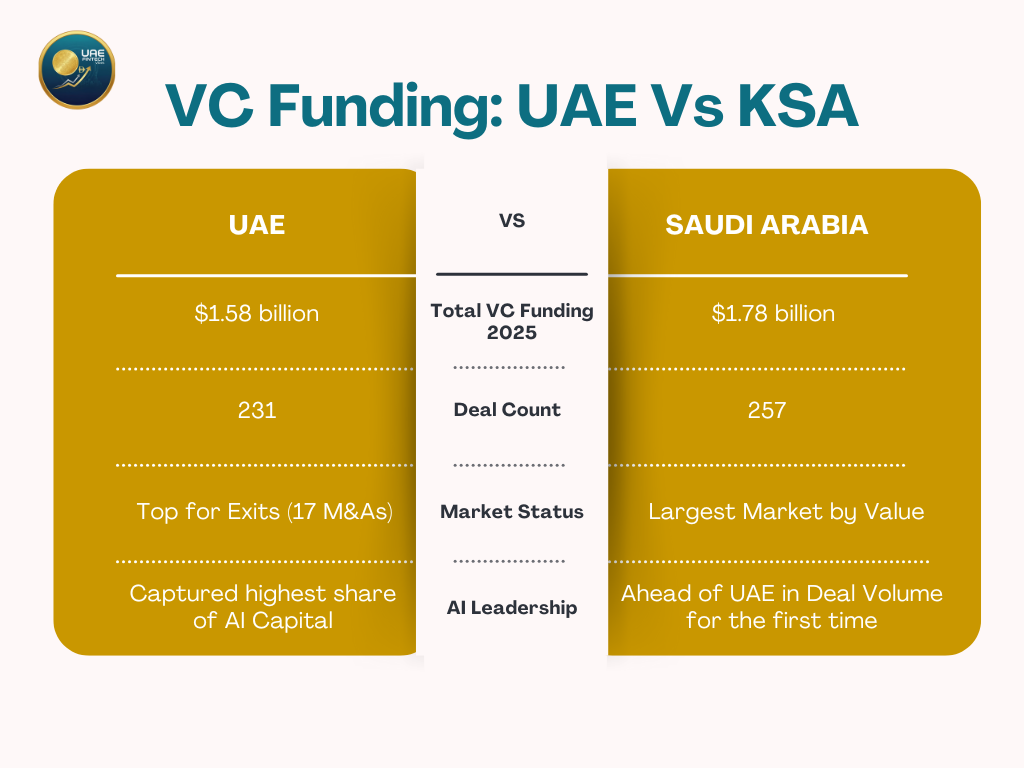
The UAE’s 2025 performance must be understood in the context of regional competition, particularly with Saudi Arabia. In the first half alone, total MENA investment reached $2.1 billion across 334 deals, with Saudi Arabia accounting for roughly 64% of capital deployed. However, the UAE still posted steady growth in the first half with $541 million across 114 startups, up 18% year-on-year.
While Saudi Arabia captured larger mega-rounds, particularly in fintech, the UAE demonstrated greater consistency and a deeper ecosystem. Even in September’s record month, Saudi Arabia raised $2.7 billion across 25 startups, while the UAE raised $704.3 million across 26 startups. The UAE’s larger deal count at comparable funding levels indicates a broader, more diversified startup pipeline.
What to Expect in 2026 – Key Trends and Predictions
Here’s what 2026 will look like for venture capital in the UAE.
AI Investment Acceleration
Here are the key points from the text converted into bullet points:
- Dominance of AI in Venture Capital: Artificial Intelligence is set to lead UAE venture capital in 2026, continuing the momentum from 2025 where MENA AI startups raised over $2.1 billion in the first half of the year—a 134% year-on-year increase.
- Massive Infrastructure Investment: Microsoft’s $15.2 billion commitment to the UAE (including $5.5 billion specifically for AI and cloud expansion between 2026 and 2029) provides the necessary foundation for startups to scale, particularly in application layers and Arabic-language models.
- Government-Driven Demand: Abu Dhabi is investing AED 13 billion ($3.5 billion) to become the world’s first AI-native government by 2027. This creates a “captive market” that reduces customer acquisition risks for startups building government-focused AI solutions.
- Shift in Investor Strategy: Global and local investment is pivoting toward AI-first strategies; with AI companies capturing 53% of global VC funding in early 2025, the UAE expects a surge in AI-specific funds and specialized investment vehicles throughout 2026.
IPO Market Revival
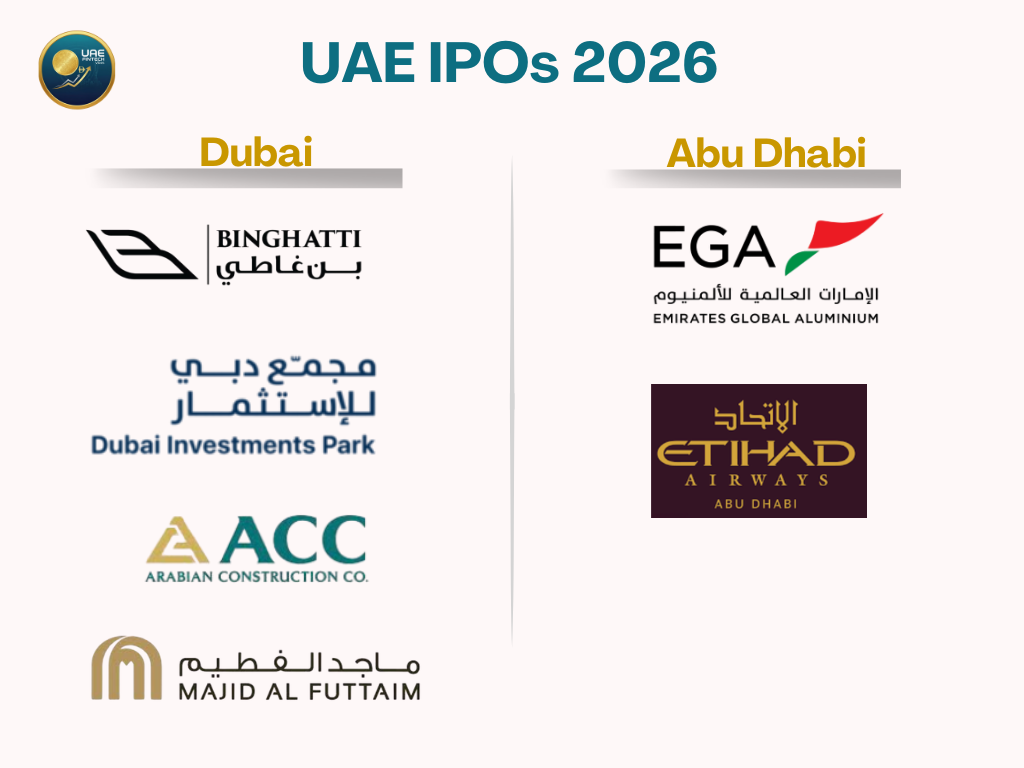
After years of muted exit activity, the UAE’s IPO market is poised for a meaningful revival in 2026. The UAE anticipates 9-12 listings in 2026 across sectors such as real estate and technology, representing a significant increase from recent years. More importantly, the quality of IPO candidates is improving dramatically.
Companies, including Tabby (UAE), are exploring near-term IPO opportunities, reflecting growing momentum in Middle Eastern capital markets that points to a rapidly maturing venture ecosystem. Tabby’s potential listing would be particularly significant for the venture ecosystem, given its status as one of the region’s highest-profile fintech unicorns.
However, challenges remain. Poor post-listing performance by major regional companies deterred others from moving ahead with IPO plans in 2025, with Lulu falling about 44% since its ADX listing and Talabat losing about 45% since its debut. This underperformance creates headwinds for near-term listings, though improving market conditions and more realistic valuations may support better outcomes in 2026.
For venture investors, the reopening of the IPO window is critical. The heavily prophesied reopening of the IPO window built significant momentum in 2025, with substantial progress in the third quarter, setting the stage for 2026 to deliver actual liquidity events rather than just market preparation.
Sector Rotation: Beyond Fintech
While fintech will remain dominant, 2026 will witness meaningful capital rotation into emerging sectors. Climate tech, healthcare AI, and Web3 infrastructure are positioned for breakout years.
In 2026, more international investors and tech companies are expected to establish local partnerships, with fintech remaining strong, but increased investment is expected in healthcare, education, and manufacturing AI. This diversification reflects both ecosystem maturity and investor recognition that the next Careem or Noon may emerge from non-consumer sectors.
Manufacturing and industrial AI, long overlooked in favor of consumer-facing applications, present substantial opportunities in 2026 as the UAE’s industrial base modernizes.
Venture Debt Mainstreaming
| Transition to Mainstream Financing | Venture debt is expected to move from an alternative option to a core component of capital structures for startups in 2026. |
| Proven Success in the Region | The effective use of debt instruments in 2025, particularly in Saudi Arabia and the UAE, has demonstrated that regional startups can successfully leverage non-dilutive capital. |
| New Market Entrants | The year 2026 is anticipated to see the rise of UAE-based venture debt funds, international lenders setting up regional offices, and traditional banks launching specialized debt products for startups. |
| Founder-Centric Advantages | Venture debt offers strategic benefits such as extending runways without equity dilution and enabling growth between formal funding rounds. |
| Alignment with Ecosystem Maturity | These structural advantages are perfectly suited to the needs of the UAE’s rapidly maturing startup ecosystem. |
Corporate Venture Capital Expansion
Corporate venture capital (CVC) will play an increasingly prominent role in 2026. CVCs accounted for 28% of all active investors in the GCC in 2024, highlighting a shift toward diversified, strategic early-stage participation. This figure understates CVC momentum, as many corporates are only beginning to formalize venture programs.
The UAE’s corporate landscape is uniquely positioned for CVC expansion. Government-linked entities, family offices transitioning to institutional structures, and large private companies all recognize venture capital as strategic rather than merely financial. Sectors particularly ripe for CVC activity include telecommunications, logistics, real estate, and energy, where incumbents face digital disruption and seek innovation partnerships.
Family Office Institutionalization
- The UAE’s family office sector is shifting toward professional management, significantly impacting the venture capital landscape.
- Managing over $1.2 trillion, GCC family offices are expanding their portfolios beyond traditional real estate into venture capital and ESG-focused funds.
- The UAE is projected to attract 9,800 migrating millionaires in 2025, contrastingly with a historic net loss of 16,500 millionaires in the UK.
- This influx of wealth is establishing formal investment programs, increasing capital commitments to venture funds and direct startup investments.
- The DIFC and ADGM provide tailored frameworks for single- and multi-family offices, offering tax efficiency and robust governance.
- These regulatory environments allow family offices to transition from opportunistic angel investing to systematic, long-term portfolio construction.
Cross-Border Capital Flows
The UAE’s role as a global capital hub will intensify in 2026, driven by rising cross-border capital flows in both directions. International VCs are establishing operations in the UAE at unprecedented rates, attracted by deal flow quality, sovereign co-investment opportunities, and the UAE as a gateway to broader MENA markets.
Simultaneously, UAE-based investors are deploying capital globally with increasing sophistication. The MGX playbook, investing in US and European infrastructure alongside financial and strategic partners, will be replicated by other sophisticated UAE investors. This bi-directional capital flow elevates the UAE from regional hub to global node in the venture capital network.
Regulatory Evolution
Regulatory frameworks will continue to evolve in ways favorable to venture capital. Abu Dhabi launched its Digital Strategy 2025-2027 in January 2025, aiming to establish the world’s first fully AI-powered government by 2027 and allocating $3.5 billion between 2025 and 2027 to boost digital infrastructure. These initiatives create both demand for technology solutions and clarity for investors deploying capital.
The proliferation of regulatory sandboxes, specialized free zones, and streamlined licensing procedures reduces friction for startups and investors. Both ADGM and DIFC benefit from customized venture capital regimes providing easier registration, reduced capital adequacy and regulatory burdens, and easier capital deployment arrangements for early-stage investment.
Expect 2026 to see further regulatory innovation, particularly around digital assets, AI governance, and data sovereignty. The UAE’s approach, encouraging innovation while maintaining appropriate oversight, positions the country as an increasingly attractive destination for companies navigating complex global regulatory landscapes.
The Infrastructure Advantage: Why the UAE Wins
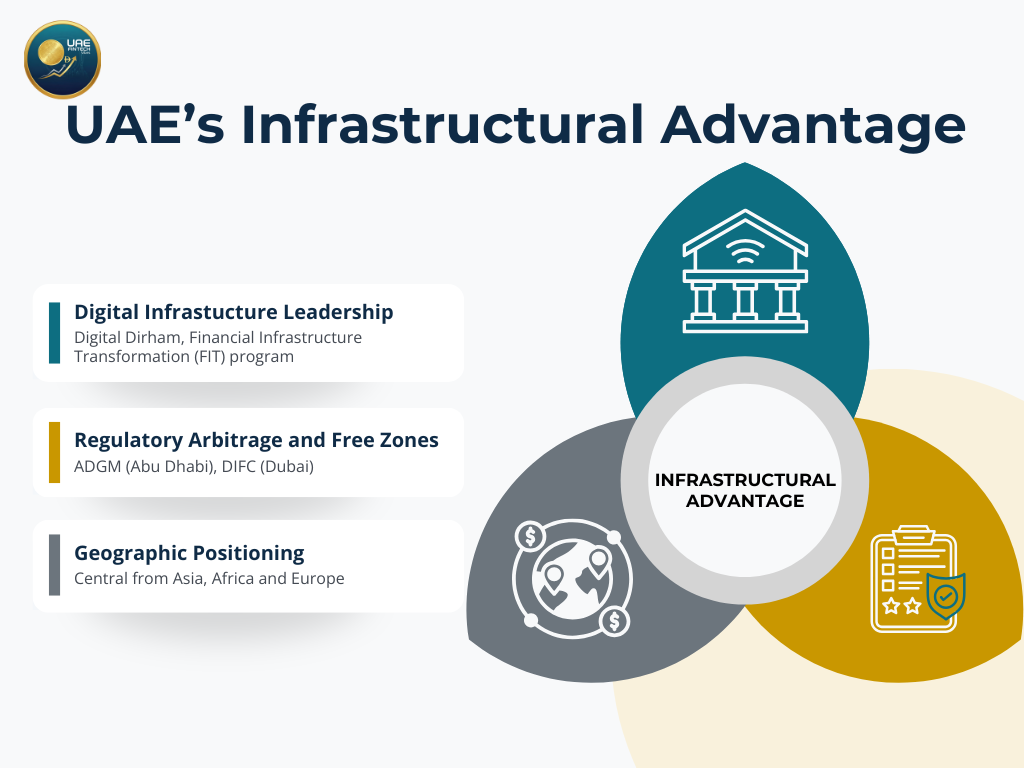
UAE ranked 4th globally in state-owned investment assets and positioned itself as a top-tier financial powerhouse, and here’s why it won that position.
Digital Infrastructure Leadership
The UAE’s digital infrastructure provides fundamental advantages for technology startups. Smartphone penetration exceeds 96%, mobile banking adoption surpassed 83% in 2025, and 69% of users favor digital wallets over cards. This digital-first population creates ideal conditions for testing and scaling technology products.
Infrastructure investments continue at a remarkable pace. The Central Bank’s Financial Infrastructure Transformation (FIT) program and Digital Dirham project are reshaping payment rails, while Microsoft’s presence in the UAE reflects almost 1,000 full-time employees and related staff representing 40 nationalities, indicating deep technology talent pools.
Regulatory Arbitrage and Free Zones
The UAE’s multiple financial free zones, ADGM in Abu Dhabi and DIFC in Dubai, create regulatory optionality unavailable in most markets. Abu Dhabi’s five specialized free zones, including Abu Dhabi Airport Free Zone, ADGM, Masdar City Free Zone, Khalifa Industrial Zone, and twofour54 Media & Entertainment Hub, offer unique incentives such as 100% foreign ownership.
This regulatory architecture enables startups and investors to select optimal operating structures. Companies can choose between common law (ADGM/DIFC) and civil law (mainland) frameworks, access specialized regulatory regimes for fintech or digital assets, and structure operations to optimize both commercial opportunity and regulatory compliance.
Geographic Positioning
The UAE’s geographic position between Asia, Europe, and Africa creates unique market access advantages. For startups, this means the ability to serve multiple high-growth markets from a single base. For investors, it means access to deal flow from three continents and the ability to support portfolio companies’ regional expansion.
Time zone positioning enables UAE-based teams to overlap with both Asian and European business hours, facilitating global operations. Abu Dhabi’s position as a bridge between East and West makes it an ideal base for AI startups looking to serve both emerging and developed markets.
Key Players Shaping the 2026 Landscape
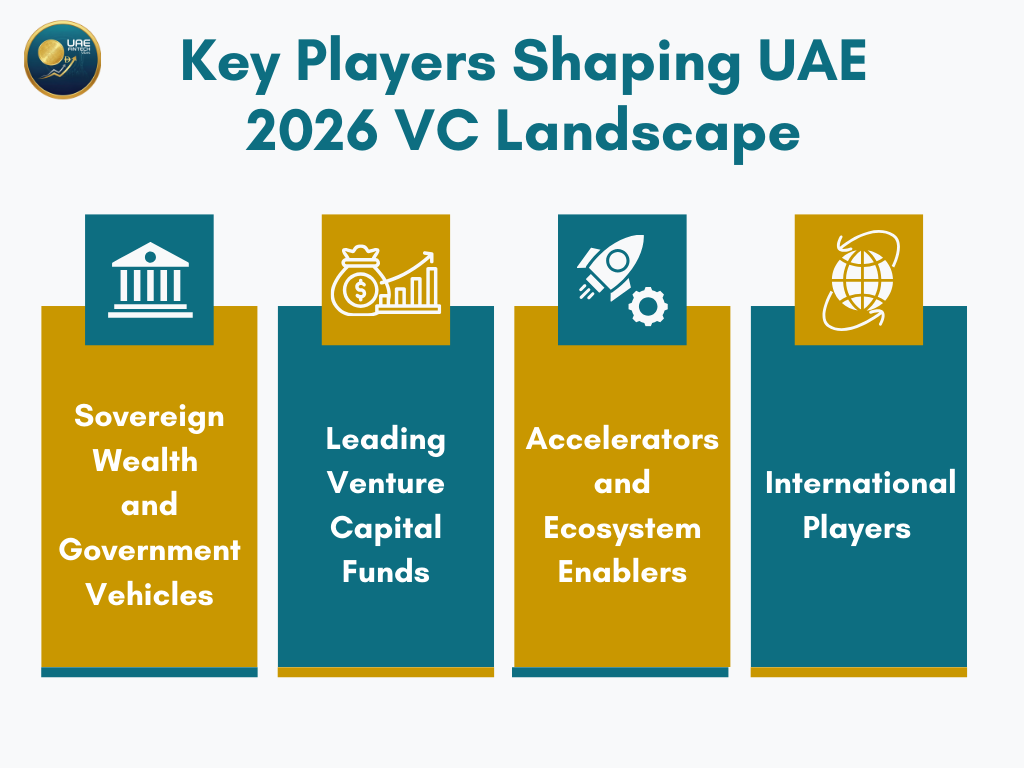
Here are the key players shaping the UAE venture capital landscape in 2026.
Sovereign Wealth and Government Vehicles
Mubadala Investment Company remains the most influential institutional investor, with a reach that extends from seed-stage startups to late-stage growth companies and infrastructure investments. Mubadala Ventures focuses on early-stage technology investments, while the broader Mubadala platform provides growth capital, co-investment opportunities, and strategic partnerships.
ADQ (Abu Dhabi Developmental Holding Company) has emerged as an increasingly active venture investor, with particular focus on fintech, digital assets, and strategic sectors aligned with Abu Dhabi’s economic diversification objectives. ADQ backed a $200 million fintech and digital assets venture targeting early-stage startups in 2022, and has since substantially expanded its commitments.
MGX represents the newest and potentially most transformative sovereign vehicle. With a consortium involving MGX slated to spend $100 billion on AI infrastructure, the fund’s impact will extend far beyond direct venture investments into ecosystem-wide infrastructure that benefits all AI startups.
Leading Venture Capital Firms
| Shorooq Partners | It has established itself as a tier-one MENA venture firm with over $500 million under management and deep expertise in fintech, software, and frontier technologies. The firm’s hands-on approach and strong track record in backing regional champions make it a preferred partner for ambitious founders. |
| BECO Capital | It pioneered institutional venture capital in the region and maintains a strong positioning in early-stage technology investments. With nine exits from its portfolio and initial investments ranging from $500K to $5M, BECO exemplifies the patient, value-add investment approach that characterizes top-performing regional VCs. |
| Wamda Capital | It operates as one of the most active regional investors with 20 unique investments since 2012. The firm’s multi-stage investment vehicle and focus on accelerating entrepreneurship ecosystems through thought leadership and research complement its capital deployment. |
| VentureSouq | It manages thematic funds with global reach, primarily concentrating on fintech and climate tech. The firm backs founders across all stages from seed to late-stage, building a worldwide portfolio of companies while maintaining strong MENA connectivity. |
| Nuwa Capital | It has distinguished itself through a founder-centric model that prioritizes partnership over traditional investment dynamics. The firm’s platform approach to supporting early-stage and seed startups resonates with sophisticated founders seeking more than just capital. |
Accelerators and Ecosystem Enablers
Hub71 dominates the Abu Dhabi ecosystem as both accelerator and ecosystem orchestrator. Beyond providing capital and incentives, Hub71 connects startups with investors, corporates, and government entities, and offers specialized programs in AI, climate tech, and digital assets.
Dubai Future Foundation operates at the intersection of government, innovation, and venture capital, supporting startups through accelerator programs, thought leadership, and connections to government procurement opportunities. The Foundation’s focus on future-oriented technologies aligns perfectly with the UAE’s long-term vision.
Flat6Labs Abu Dhabi provides intensive early-stage support, including funding, mentorship, and business development assistance. The accelerator’s focus on building strong foundations for startups addresses critical needs in the earliest stages of company building.
International Players Establishing Presence
Global venture firms are establishing UAE operations at an accelerating rate. Andreessen Horowitz, Sequoia Capital, and other tier-one firms have invested in MENA and are evaluating a more formal regional presence. This international interest validates the ecosystem’s maturation and creates opportunities for co-investment and knowledge transfer.
Challenges and Headwinds for 2026
There’s no doubt that 2026 is the year of growth and opportunities, but it can also bring challenges.
Valuation Discipline vs. FOMO
The tension between valuation discipline and fear of missing out on high-quality deals will intensify in 2026. The success of 2025 created momentum that could lead to overheating, with valuations disconnecting from fundamentals. Sophisticated investors will need to balance competitive deal processes against maintaining investment discipline.
Investors are prioritizing companies with strong unit economics, growth, and defensible market positions, with only the strongest competitors attracting substantial funding. This selectivity will be tested as competition for top deals intensifies.
Exit Environment Uncertainty
While IPO markets show improvement, execution risk remains substantial. The poor performance of recent listings creates an overhang, and the limited depth of regional public markets constrains exit options. Strategic M&A activity, while growing, hasn’t yet reached levels necessary to provide consistent liquidity for venture portfolios.
The scarcity of exits creates portfolio management challenges for older funds and may lead to down-rounds or difficult restructurings for startups that raised at peak valuations but cannot grow into them. This dynamic will separate strong from weak performers.
Talent Competition
The UAE’s growing technology ecosystem creates fierce competition for specialized talent. While the Golden Visa and other immigration reforms attract global talent, demand still exceeds supply in critical areas like AI engineering, product management, and experienced startup operators.
Salary inflation in high-demand roles could pressure startup burn rates, while larger companies and international tech firms increasingly compete for the same talent pool. Building and retaining exceptional teams will be a key determinant of startup success.
Regulatory Complexity Across Emirates
While regulatory innovation creates opportunities, navigating multiple regulatory regimes (mainland vs. free zones, Dubai vs. Abu Dhabi frameworks, federal vs. local regulations) can be complex and create friction. The UAE comprises 67 free zones with varying regulatory frameworks, and founders must carefully structure their operations to optimize across multiple dimensions.
Regulatory alignment efforts are ongoing, but in the near term, startups and investors must develop a sophisticated understanding of regulatory landscapes to avoid costly mistakes.
The Road Ahead: Positioning for Success in 2026
For founders considering the UAE, the opportunity has never been stronger. Access to capital across stages, government support for innovation, world-class infrastructure, and expanding talent pools create ideal conditions for building ambitious companies. The keys to success are choosing the right regulatory structure, building relationships with ecosystem players before fundraising, and demonstrating traction and unit economics that meet increasingly sophisticated investor standards.
For investors, the UAE presents compelling risk-reward dynamics but requires local understanding and relationship networks to access top-tier deals. International investors should consider establishing a formal UAE presence, partnering with local funds, and developing deep sector expertise in AI, climate tech, or fintech, where the UAE has clear competitive advantages.
For corporates and family offices, venture capital is transitioning from optional to strategic. The pace of disruption across industries makes venture programs essential for understanding technology trends, accessing innovation, and building relationships with potential acquisition targets or strategic partners.
Conclusion
The UAE has evolved from a regional venture capital leader to a global hub, with 604 funds investing over $1.61 trillion in more than 7,200 companies. As 2026 approaches, the venture capital landscape will be shaped by AI dominance, better exit opportunities, sector diversification, and ongoing competition with Saudi Arabia. The fundamentals, government support, capital availability, infrastructure, and founder ambition are robust.
The UAE presents unique advantages for founders, investors, and innovators. This evolution showcases how sovereign wealth, regulatory innovation, and strategic vision can create world-class innovation ecosystems. The UAE is demonstrating that even young ecosystems can thrive on the global stage.
Read the latest Banking news on UAE Fintechvibes to know what’s happening in the UAE Fintech.